

Updated 2026-07-09
How to measure AI visibility (without just trusting a vendor's score)
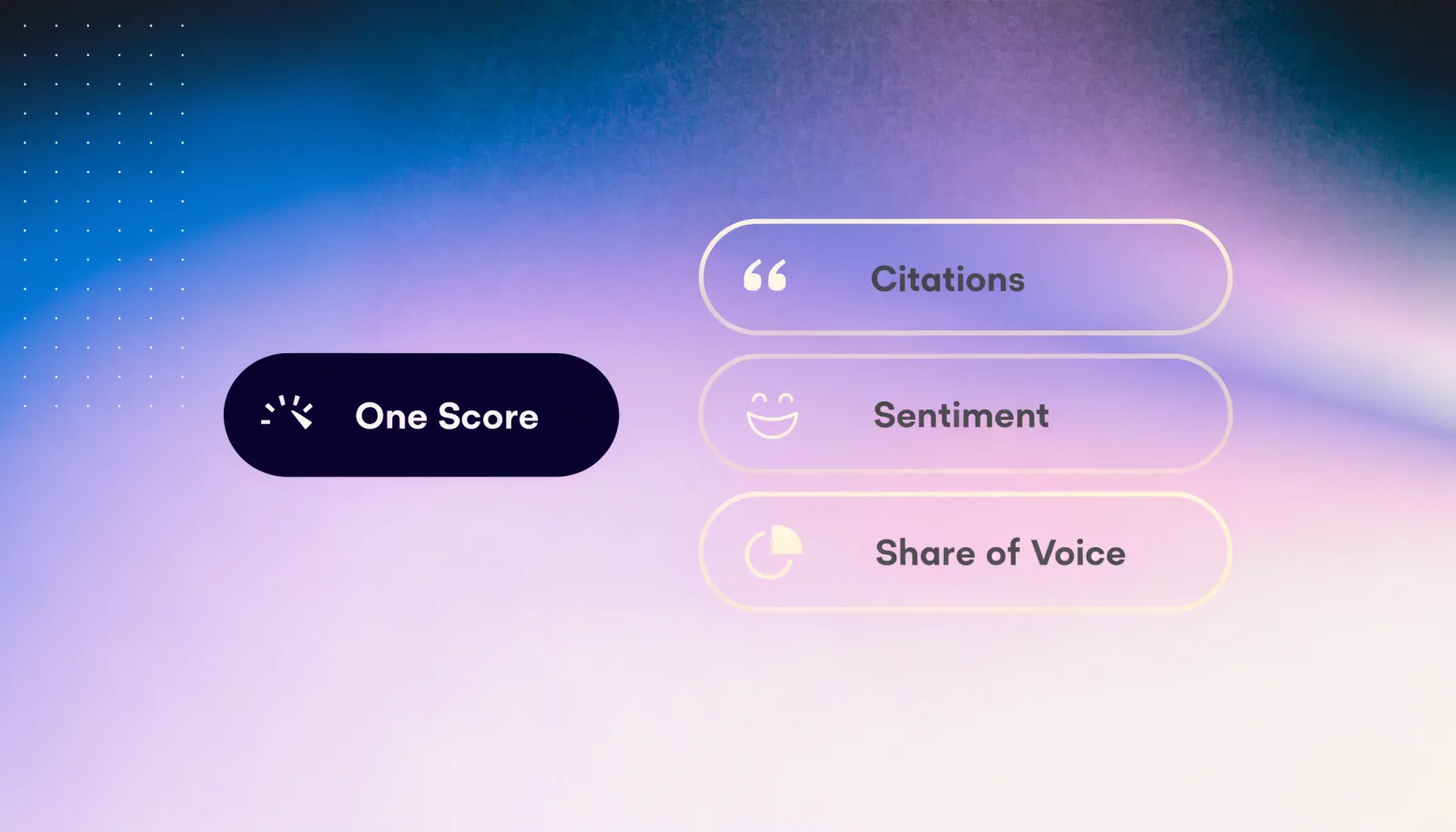
AI visibility measurement is tracking how often, how accurately, and how favorably a brand appears in answers from ChatGPT, Perplexity, Gemini, and Google's AI Overviews. Every score on the market is modeled from sampled test prompts, not real user behavior — honest measurement means running real prompts across models and tracking citations, sentiment, and share of voice over time, not accepting a single blended score.
That last part matters more than most guides admit. Over the past few weeks, the AEO/GEO world has been having a fairly public argument with itself about exactly this.
The AEO hype cycle just hit its boomerang phase
Six months ago, the advice was simple: forget SEO, go all-in on Answer Engine Optimization. Lately, parts of the same industry have started walking that back, in public.
The argument making the rounds boils down to this: AI visibility and search traffic were never the same currency. A mention inside an AI answer doesn't convert the way a click from someone actively comparing prices does — Google still owns that moment of intent. A related thread put a harder number on the credibility gap: plenty of firms now market themselves as AI-search specialists, but only a small minority of them actually track AI citation visibility in any rigorous way.
Neither argument is that AI visibility is fake or doesn't matter. It's narrower and more useful than that: a lot of people are now claiming to manage it who have never actually measured it. That's the gap this guide is trying to close.
The methodology problem nobody's answering
Most "how to measure AI visibility" guides walk through steps and then quietly skip the uncomfortable question: how much should you trust the number a tool hands you?
Citation rates for the same prompt can vary by dozens of times across different platforms, and a single blended methodology hides more than it reveals — count mentions across wildly different retrieval systems, call it one score, and you're counting mentions and calling it strategy, not measuring anything.
That critique is hard to argue with, and it's not a flaw you can average away. ChatGPT, Perplexity, Gemini, and Google's AI Overviews retrieve and phrase answers differently enough that a brand can look strong on one and nearly invisible on another — for the exact same prompt. A single blended "AI visibility score" smooths that variance into one number, which is convenient for a dashboard and misleading for a decision.
The more basic version of the same point shows up across the industry too: no tool on the market has 100% accurate insight into what real users are actually typing into these systems. Every third-party score — including PilotCite reports, and including the framework below — is built from sampled test prompts, not live user data. That's a limitation to design around, not a reason to give up on measuring.
What actually moves the needle
Strip away the vendor dashboards and the durable signals converge on roughly the same five things:
| Vanity signal | Track this instead |
|---|---|
| Raw mention count | Citation frequency & citation share — how often you're cited with a link, not just named |
| "Positive/negative" label | Sentiment accuracy — is the model describing you correctly, not just kindly |
| One platform's score | Cross-platform consistency — same prompt, checked across ChatGPT, Perplexity, Gemini, and AI Overviews |
| A single point-in-time score | Freshness correlation — whether updating a page changes your citation rate over the following weeks |
| Visibility in isolation | Share of voice — your citation rate against two or three named competitors on the same prompts |
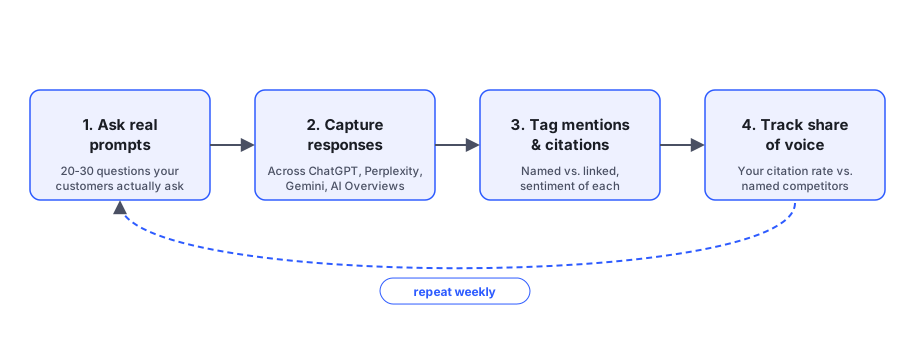
These map cleanly onto the metrics that actually matter: citation rate, brand-mention rate, share of voice, and sentiment — each with a different failure mode when misread.
A practical baseline you can run this week
- Write 20–30 real prompts — questions your actual customers would ask, not your brand name. Pull them from sales call transcripts or support tickets if you have them; guessing produces unrealistic prompts. Your prompt set is the targeting list.
- Run each prompt across at least three models (ChatGPT, Perplexity, and one more) and log three things per response: did you appear, were you cited with a link, and was the framing accurate.
- Repeat the exact same prompts a few days later. If your presence swings wildly run-to-run, that's real information — it tells you how volatile your visibility currently is, not that the tool is broken.
- Add two or three named competitors to the same prompt set so your numbers mean something relative, not just absolute.
- Log it somewhere you'll actually revisit — a spreadsheet is fine at this scale. The value is in the trend line, not the first snapshot.
This gets tedious past a few dozen prompts run weekly, which is the honest reason tracking tools exist — not because manual testing is wrong, but because it doesn't scale.
How to tell a real measurement tool from a vanity score
If you do bring in a tool, the methodology questions from the section above don't go away — they just move from "can I trust this number" to "can I trust this vendor's number." A short checklist before you commit:
- Does it show you the actual prompts it tested, or only a final blended score?
- Does it separate mentions from citations, or count both the same way?
- Does it break results out by platform, or hide cross-platform variance in an average?
- Does it let you re-run the same prompt set over time, so you're watching a trend rather than a single reading?
- Is it honest anywhere in its own materials that these are modeled estimates, not observed user behavior?
A tool that can't answer the first two questions plainly is selling you a scoreboard, not a measurement. Citation monitoring that surfaces the underlying answers — not just a blended index — is what makes a number defensible in a review.
- Every AI visibility score is modeled from test prompts — none observe real user queries.
- Track citations (with links), not just brand mentions, and break results out by platform.
- A single blended score hides cross-model variance that should drive decisions.
- Baseline 20–30 real buyer prompts, re-run on a schedule, and compare against named competitors.
- Insist on prompt-level evidence: a number you cannot trace back to an answer is not measurement.
Frequently asked questions
AI visibility is how often, how accurately, and how favorably a brand shows up in answers generated by ChatGPT, Perplexity, Gemini, Claude, and Google's AI Overviews. It matters now because a growing share of people ask these tools a question and never click through to a website at all — if you're not in the answer, you're not in the consideration set.
SEO rankings are a single, publicly checkable position on a results page. AI visibility is probabilistic — the same prompt can return a different answer minutes apart, and there's no public rank to check. You're measuring a pattern across repeated prompts, not a fixed position.
Because each tool tests a different set of prompts, against different models, at different times, and rolls the results into its own scoring formula. None of them see real user prompt data — they're all sampling and modeling. Two honest tools measuring the same brand can reasonably land on very different numbers.
Yes, at small scale. Manually running 20-30 realistic prompts through ChatGPT, Perplexity, and Gemini and logging whether your brand appears, whether it's cited with a link, and the sentiment of the mention gives you a real baseline. It doesn't scale to hundreds of prompts without tooling, but it's enough to start.
A weekly check on your highest-priority prompts is enough to catch real trend shifts without chasing day-to-day noise, since answers can vary between runs of the same prompt. Save deeper competitive benchmarking for a monthly cadence.
No. Many AI answers resolve the user's question without a click at all, so a strong visibility score can coexist with flat referral traffic. Visibility is closer to a brand-awareness metric than a direct-response one — pair it with branded search volume to see if it's moving business outcomes.
A mention is your brand name appearing in the generated text with no link back to you. A citation includes a clickable source link. Citations are rarer and more valuable — they're the only form of AI visibility that can produce a direct visit.
There's no fixed timeline, because it depends on how often the model's retrieval layer re-crawls and re-indexes your content. Some tools report measurable shifts within a few weeks of structural changes; treat any specific number here skeptically until you've watched your own baseline move.